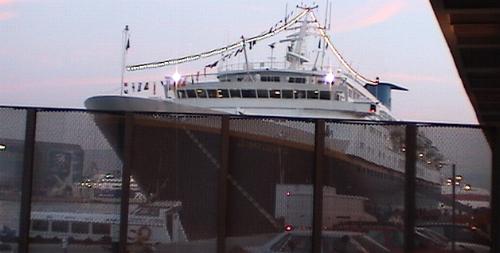
We put our luggage outside the door that evening and early the next morning when the ship docked we hurried to the bus to get an early start to the
airport. Even so, there was heavy traffic to the airport and we took some side streets to avoid a jam or two. The two groups separated there, some of us going on to Istanbul and the rest
returning to Chicago. After a very short flight we were back in Turkey. After parting with $75 for a visa, we met our tour guide for the next few days, Dilek Yarcan.

Soon we were bussing it along the city. Dilek explained some of the history of this city. Originally called Byzantium, it was renamed to
Constantinople when Constantine made it the second capital of the Roman empire in the fourth century, and finally adopted the name Istanbul when Mehmet II's Ottoman armies conquered the city in 1422.
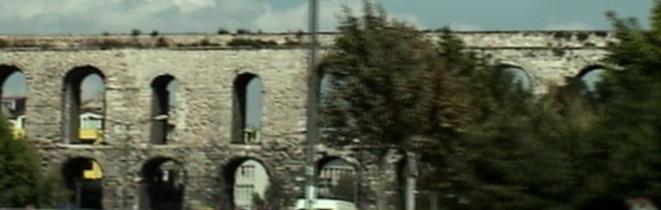
We passed through the aquaduct of Valens, that was constructed in 375 by order of Roman Emperor valens. It conducted water from the Belgrade Forest to the nymphaion fountain in the Bayezid Square.
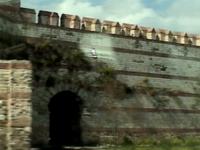
We passed by a piece of the land walls that protected the city. Dilek pointed out several other places of interest that we might want to investigate on our own during this stay.
She was pretty emphatic about not drinking the local water.
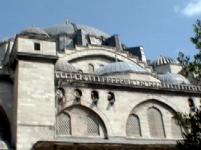
Soon we arrived at our first place of interest, the Mosque of Suleyman the Magnificient.
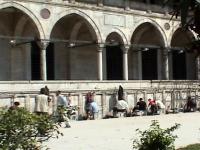
It was nearing one of the prayer times so many persons were purifying themselves in teh front of the Mosque. We couldn't begin our tour of the inside for a while, so we wandered around
outside and marvelled at the exterior of the building.

We were excused for 10 minutes to view the outside and surrounding buildings until the mosque would be clear for tourists.
Remy spent the time in the ladies room, while I took photos of the shops with the cupulas showing through the roofs. Dilek had explained that the mosque was more
than just a prayer house, but also included hospitals, shops and other commercial enterprises. There was a good view of the river from the one side.

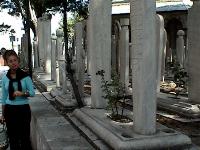
Dilek next brought us to the back of the mosque where she pointed out the gravesites of some of the important personalities.
In this graveyard are members of the palace, men of importance in religion, high ranked members of the military, etc.
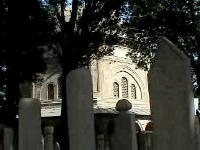
In the middle of the gravesyard is the tomb of Suleyman the Magnificent. It is situated such that persons prostrating to God in the mosque face Mecca, are also
symbolically prostrating towards him. Near his tomb is the tomb of Roxelan his wife and Sinan the architech for the mosque.
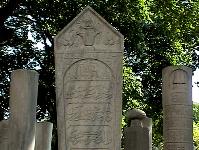
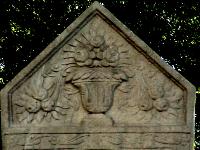
Tombstones are placed both at the head and the foot of the person buried beneath the ornate marble boxes.
She first pointed out the beautiful art work on the tombstones with the flowers and fruit symbols. Then she explained that the bodies are not
buried in those boxes, but rather 3 meters below.
The dead body is wrapped with a white shroud, textile piece. The marble box is symbolic, just pointing the location. No preservation of the body is done.
They believe the body should get disintegrated into the earth.

Finally as we entered, Dilek explained that this mosque was designed by Ottoman's most famous architect, Sinan. Comparable in importance as Frank
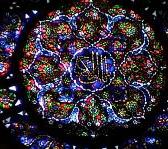
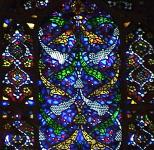
Lloyd Wright was to Chicago architecture. The most ornate wall with the large stained glass windows is the one faced by those that are praying towards Mecca, their holy city in Saudi Arabia.
In the central part of this wall is a marble niche, called mihrab. Mihrab, means a symbolic gate to paradise. By means of praying toward mihrab, they are supposed to leave the worries of the
physical world behind and enter into world of the divine beyond it.


At our feet were the prayer carpets. Here they have permanent ones installed that Dilek then explained.
We were on the women's side of the rail that diffentiates the area where the men pray from where the women pray. Women also use a balconey in the back.
First you will notice the individual spots on the carpets all point towards the holy city of Mecca.
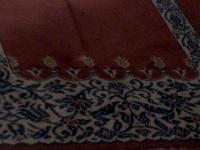
Each carpet has a symbolic gate to paradise at the center of the mats that each person would straddle when they kneel.
Common symbols on all prayer carpets are the flowers: Tulips and Carnations.

Carnations symbolize Wisdom. Carnations are seen often on prayer carpets because "the road to the divine is shown by Wisdom".

Tulips are special for two reasons. First, their name spelled backwards (left to right) in Arabic is the same as the word for Allah.
The second reason is that they are like the state flower since they are native to the country of Turkey. So you often find them stained glass window, costumes on praying carpets, tiles and other items.
In the 16 th century a Dutch ambassador brought some back with him, and it has since become a very important product for the Netherlands.
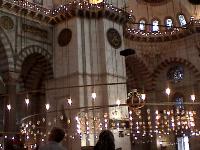
Dilek's explaination was interupted by some very loud children, whom she went to quiet down. Their voices echoed througout the mosque. She explained that the
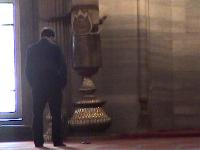
acoustics in the building were very good, due in part to some very large empty water jugs that Sinan had placed in the walls behind the caligraphical circles. They were so placed to reverberate and amplify
the sounds.
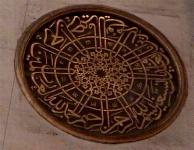
The plate's themselves were prepared by the artist Hasan Celebi and the black background for them was prepared from the soot generated by the oil lamps that light
the mosque at the time.
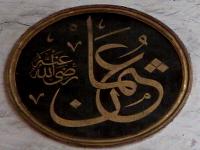
These plates as well as others placed throughout the area contain the names of important persons of Islam and verses from the Koran.
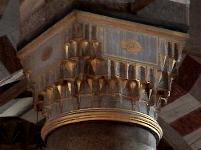
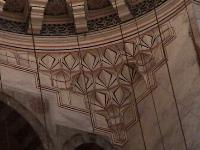
We were then excused to view the architectural wonders of this building. The features of this building were evolved from the design of the Hagia Sophia which we were going to see tomorrow. A key
feature being the huge dome supported by four columns that are said to symbolize the first four caliphs of Islam.
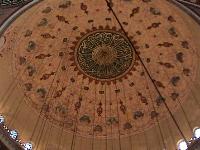
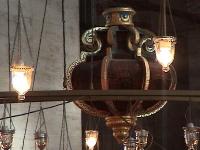
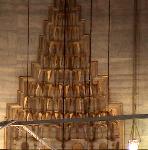
When questioned about the large madellion in the middle of the chandelier, Dilek explained that it was a symbol of the Power of the Sultan.
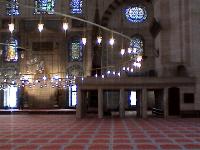
The small colonade on the one side was explained to be an informal/spontaneous meeting area. Men would casually gather here after the prayer
services to discuss issues of the day.
|