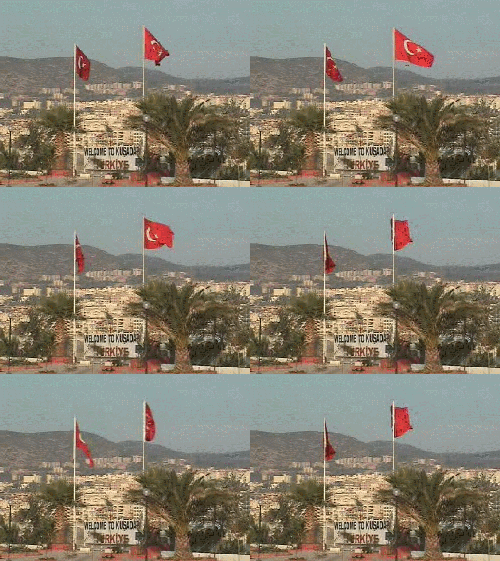
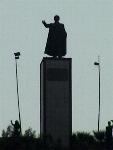
After lunch we continued to cruise to the town of Kusadasi which is in Turkey.
Exiting the boat we were looked down upon by a statue high up on the hill overlooking the town. This is a statue of one of Turkey's
military heroes, Ataturk. He led a struggle for an independent land of Turkey after World War I, which had left all the cities of the Ottoman
empire occupied by allied forces.
We were met by a Turkish guide and headed off by bus up Mount Pion to the House of Mary. This house outside Ephesus
was first mentioned by a German Nun, Anna Katerina Emmerick in her book about the "The Life of the Virgin Mary". It is believed that St. John came to Ephesus with Mary around the year 42.
Ephesus is also associated with Mary because the Ecumental Council of 431 met in Ephesus where it declared her divine
maternity.
It was a refreshing walk from the bus up a wooded path to the house, and outside the house we passed by some flowing springs
before coming to a wall where everyone was depositing their petitions similarly to the crying wall in Jerusalem.
Near by we found the ruins of ancient Ephesus. Apparently an earthquake changed the route of the river and what used to be a port became dry
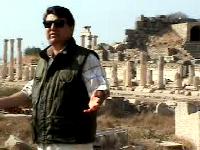
land which led to the relocation of the population to the present town of Kusadasi. We got a local guide for the this tour who pointed out what could be seen of the ancient town. Only about
25% of the buildings have been excavated.
I had a little trouble hearing him in the open air of the site, plus it wasn't always clear which building he was referring to, so if I identify something wrong, correct me.
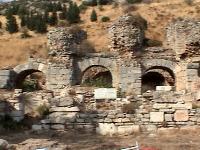
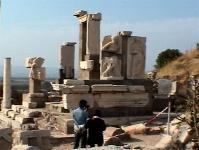
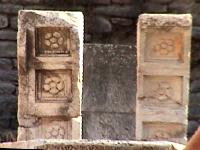
One of the first ruins we came to was the remains of a Roman bath. The stacks are seen from the Tepidarium and the Caldarium, the lukewarm and hot sections.
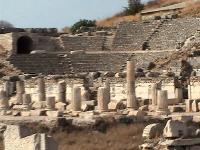
Then we came to the Odeion which was built around 150 AD. It was used as both a concert hall and council chambers. It seated 1400 spectators in 23 rows. It was a bit unusual in that the seats were
divided into 2 parts by a passage across the middle.
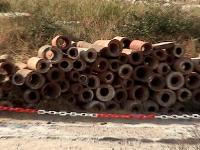
A characteristic of the Roman Settlements is the advanced state of plumbing. Here we saw some piles of the pipes that were used to
handle the sewage.
The Prytaneion was part of complex where religious ceremonies and reception parties were held.
Members of the Prytanship kept an eternal flame for Artemis of Ephesus burning. She was a goddess of fertility.
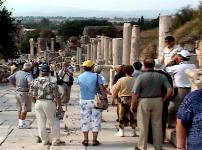
From there we headed down a long roadway lined with columns and paved with marble slabs, Curetes Street.
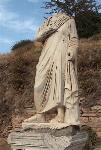
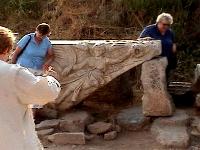
It suffered from many earthquakes over the years and fragments of statues and differing construction materials characterize the pathway.
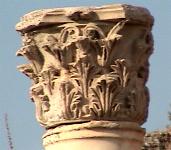
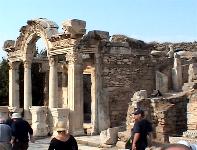
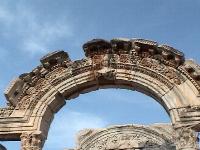
Next we arrived at a building that had been dedicated to the Emperor Hadrian. The facade of the building is formed by four columns that support
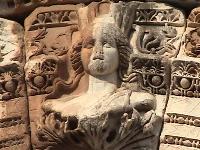
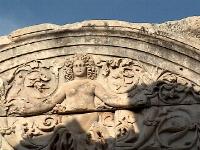
an arch. The keystone of the arch contains a carving of the Tyche, the goddess of the city. The door leading to the main part of the temple has a semi-nude
figure of Medusa with flowers and leaves.
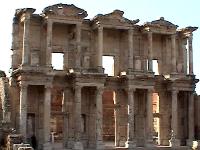
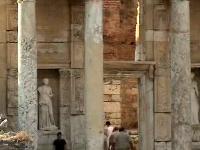
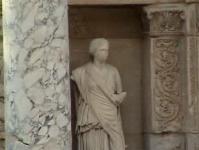
The Celsus Library actually came into view a long time ago. This two storied building was visible when we first started walking
down the road. It was built in 105 AD by Julius Celsus Polemanus a proconsul to honor his father who died at the age of 70. Although the facade is two storied, the
inside was one large room. Before we arrived here we had been given a library pass. The mens pass was to allow passage to the building across the street from the
library.
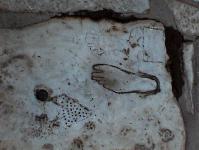
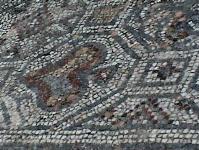
In case you hadn't used your blue ticket, we came upon a sign in the sidewalk pointing you back to the building across from
the library where you might find a woman who would respond to the desires of your heart.
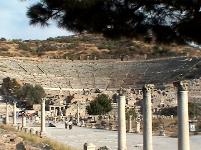
Finally we came to the Grand Theatre originally built in the 3rd century BC. It could seat 24,000 people. The theatre besides
serving for classical plays was used as an arena in the 3rd and 4th century AD, where gladiator and animal fights were staged. It also served as an assembly for meetings called
Demos attended by all the Ephesians and once by St. Paul, where the riot against him broke out.
En route to the ship, we made a quick stop at a carpet show room where we got a demonstration of the various types of carpets. Click here to go to see some pictures of this Carpet Demonstration |