
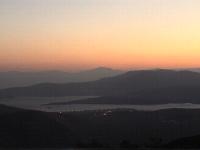
When we arrived at the Amalia hotel in Delphi, we quickly got our keys and retired to the room. Some of the travelors visited the swimming
pool that was handy. Remy took a nap while I watched the sun go down over the Ionian Sea. Once it got dark, we joined a few others on a short walk to shop for T-shirts, etc.
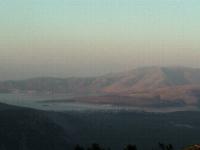
As the sun came up the next morning, the view of the Sea became increasingly clear as the light fog burned off revealing the port town with cruise boat
and all the buildings whose lights marked the town that evening.
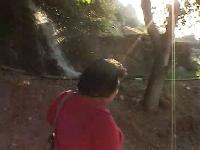
After a short bus trip we were let off on a rocky path past a Castlian Spring and on to the Athena Pronaia. Pronaia means "before the temple". This is the area where the pilgrims would stop for purification and bathing
before they would go up the hill to the temple area. Just above here were the ruins of Athena's Temple and looking further up the hill we could see the ruins of the Temple of Apollo - where pilgrims came to visit the goddess of wisdom and to hear the oracle.
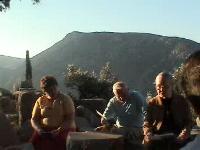
So it was here that we celebrated Mass with Karl Mueller and Rosalie Plosnich reading from 1Corinthians 14:1-19, dealing with the speaking in tongues and prophesies. The sounds of the water falling and Rosalies faint voice made us listen even more attentively to words being spoken. Father Bob then interpreted those words for us. Click here to download a video of the readings Delphi Readings
We continued into the area known as the Athena Pronaia Sanctuary . These rocks date from the 7th century B.C.
The most prominent ruins here is the Tholos, a round Doric temple.
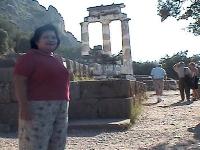
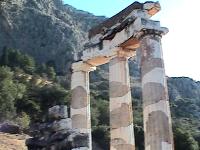
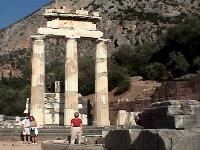
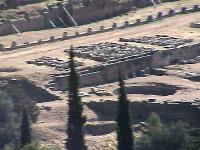
From our vantage point here we could see additional ruins just above un near the road, but we continued to the main
ruins of Apollo area. One of the vantage points on the climb up near the temple of Apollo allowed us to look back down on this area and from
there we could see the Gymansium area with its round bath and straight track.
Next we went to the upper side of the road and entered the Temple of Apollo grounds. The myth went something like this:
Apollo and Artemis were the children of Zeus and Leto. Hera, the wife of Zeus was jealous of the pregrnant Leto, and pursued her such than no where could she find refuge to bear her children. Eventually, the barren island of Ortygia gave her sanctuary and it was there that Artemis and Apollo were born. Apollo is considered the god of the Sun, of prophecy and Music. As soon as he saw the light, the island began to glow and to this day Ortegia, now named Delos, has an odd glow to it.
When he was 4 days old it is said, Apollo came to Delphi and killed the Dragon Pytho with his bow and arrows. As a result he was called the Pythian Apollo from which the Pythian Games obtained their name as well as the priestess of the oracle, Pythia. Pythia would squatted on the sacred tripod inside the god's oracle, and made prophecies. She was positioning herself above the ground where Apollo had buried Pythos.
The way this worked was that the pilgrims would come to Delphi and spend some time at the baths purifying themselves. When they were ready they would proceed to the temple area by way of the markets where they purchased a shield or sword, knife, etc to be used as an offering to the god Apollo. The temple priest would take the offering and arrange for the Oracle, the Pythia, to enter the temple room on his behalf. She would sit on a stool above a fuming entrance to the earth and would enter a trance from which she would babble a guidance for the pilgrim. The priests would then interpret the babblings for the pilgrim, often using language that could mean several things.
According to Aleca, the priests had a spy network throughout all of the Grecian cities so that when influential pilgrims came here, they had an idea of their potential. So for a good leader they might prophesy that they would lead a conquest of some lands and establish a colony there, with the intent
that they should take citizens from an overpopulated area and move them to the suggested lands. In this way they encouraged the development of the Grecian empire.
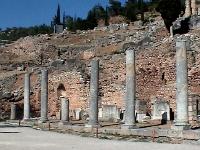
First we gathered just inside the entrance to the Temple and waited as some visited the WC, etc. Aleca gave the description I re-iterated as best I could above. However, lots of tourist were there this day, and they weren't being to quiet for the tour guides trying
to tell a story, so I may have missed some of the important points, if so go ahead and correct me. Anyhow, this is the market area where the pilgrims would purchase their offerings to the god Apollo.
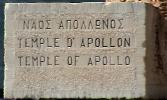
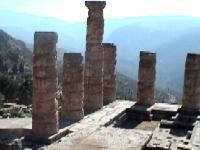
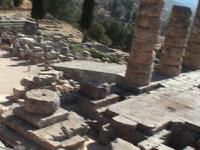
Continuing up the hill, we came to the Temple itself. These three pictures are of the main temple. The pillars were each named.
We tried to figure out which of the rooms had the oracle stool in it, we couldn't be sure, but I think this one was a prime candidate.
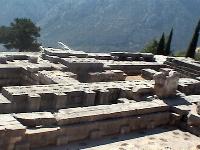
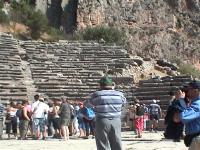
Continuing up the hill, we came to a 5000 seat theatre that supposedly had great accoustics.
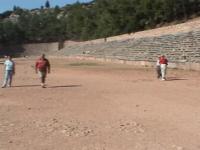
Even further up the mountain one comes to the Athletic stadium where they held the foot races for the Pythian Games.
The stadium is 650 feet long and the seats are a little bit hard.
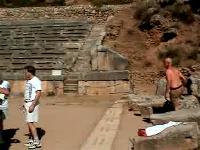
You can see the starting blocks cut into the stone blocks at the one end of the stadium.
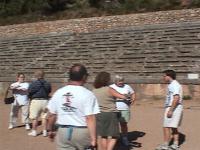
All of us who successfully made the climb were winners this day, but Robert was the most victorious of us all.
To download his victory click Roberts Victory.
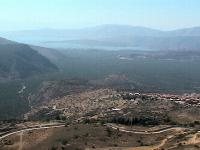
Leaving Delphi we stopped for one last look back from the heights of the Maniatis Chalet where we stopped for lunch and souvenirs.
After a long bus ride we arrived in Athens.
After a long bus ride we arrived in Athens.
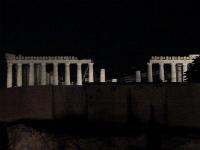
There was a Taxi strike so we dropped Aleca off near her house so she could get her car. We went on to the Herodian Hotel, which was
located directly underneath the Parthenon.
After a short walk to see the restaurants and stores, we headed back to the hotel for drinks under the Parthenon, and then down stairs for dinner.

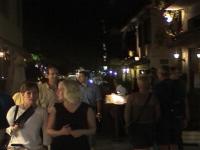 We rested awhile, then Father Bob gave us a guided walk to the Plaka, pointing out the statues along the way that signal you haven't gotten lost yet.
Athens
Itinerary