
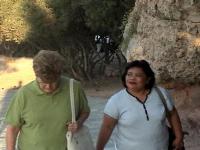
Up early (to beat the crowds), and onto the bus, we cruised about a block and a half to the entrance for the acropolis.
The trek started out as a relatively steep ascent.
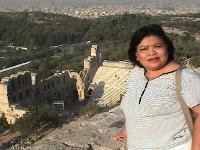
Along the way we got a view of the Theatre of Herod Atticus over the hill. Last night we could see the lights coming out of this
area from our perch on the roof of the hotel. Some of our fellow travelers actually went there and crashed the second half of a concert.
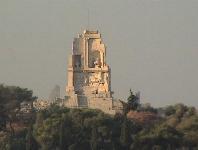
A little further up the hill and we needed to rest again. Here Aleca pointed out some of the points of interest within our view.
The Monument of Philopappos sits atop one of the hills that sticks up around the Acropolis. This monument was apparently put to Philopappos's honor. He was famous for his
traveling around the world and speaking about Greece Culture and perhaps had a big influence on the Romans.
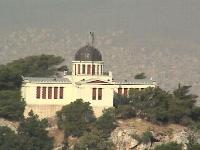

Another prominent building that I was thinking was a church with its black dome, is actually a metereological station or an observatory.
Close to it is a prominent looking church: Aghia Marinas named for a martyr for the church from an early period.
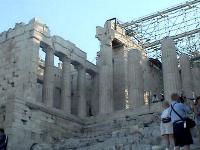
The main entrance to the Acropolis was a smaller temple, called the Propylaia, which means before the Temple.
It was designed with some extra large diameter columns that were mainly intended to impress the visitors entering the Temple area.
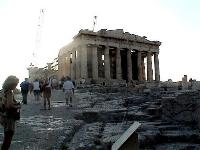
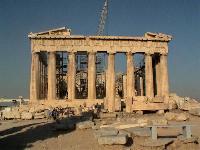
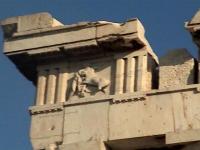
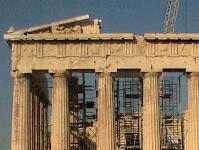
And finally we could see the main attraction in site, the Parthenon. This is the Temple for the Virgin (in Greek "parthena") Athena.
It was build of marble on the site of two previous temples and took 15 years to build (447-432 B.C.)
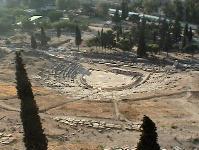
Additionally we were able to look down upon the Theatre of Dionysus. This is where the plays of Sophocles, Euripides and Aristophones were first presented.
Originally this theatre had wooden seats, but were replaced by the stone seats in 342 BC. It could seat 20,000 spectators. The orchestra pit, the semi-circle between the spectators and the stage, was rebuilt by the Romans for gladiator performances.
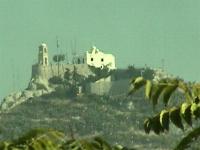
On another far hill one could barely make out the Church of St. George although the hill it was constructed on appeared to be even higher than that of the Acropolis. Several members of our group took the sub-way and then a cable car to
view the church more better.
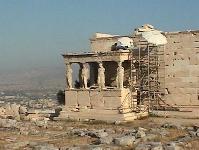
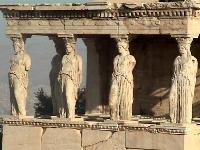
Continuing back down the hill we came to the Erechtheum a Temple famous for the Caryatids, young priestesses who support the temple's roof with their heads.
Erechtheum was later identified as Poseidon. The legend was that Athena and Poseidon contested for the protection of Athens and Athena won when she produced the Olive tree. That's why her Temple
is larger and higher up on the hill than his.
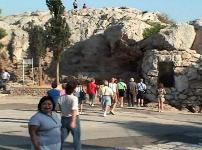

Then we proceeded down to the Areopagus or Hill of Artemus or Mars. This is the location where Plato was found guilty and asked to drink of the Hemlock.
Also according to the Acts, the place where Paul addressed the Athenians thinkers. Dee and Alora read the Paul's speech about the unknown god. Father Bob went on to explain
how Paul used their practices to explain their beliefs and practices in the light of the coming of Jesus. Apparently the Athenians had a hard time with the concept of resurrection.
You can download the reading by clicking Here for the Areopagus Readings .
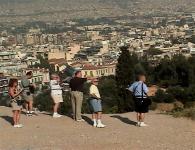
Next a few of us climbed the large steps and steep rocks to a view of the Agora. over the other side we were able to see the Agora, or market place.
From this perch you could see a long distance view of Athens. You could see the foundations of plenty of ruins in the Agora.
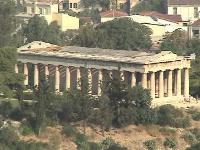
The Temple of Hephaestus stood out among the ruins there. Since we did a walk through of the Agora on our free day, you will see more of what was there on tormorrow's shots.
We carefully crawled back down off this hill and headed back down towards the bus. Plenty of folks were going the opposite direction up the hill, so the early start payed off.
The bus took us for a tour of Athens, which was heavy with traffic due to the taxi strike. We passed the olympic stadium that had been rebuilt for the 1896 olympics.
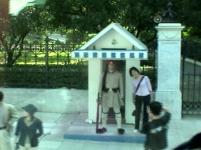
We came to the government area by the President's and Prime Ministers houses. From the bus we could see other tourists posing for photos with the ceremonial guards.
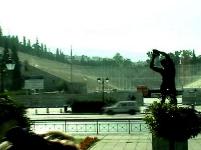
On the second pass of the Olympic Stadium we got a little better view of the seats. The stadium was closed for remodeling for the upcoming Olympics.
We left town and headed for Corinth.