
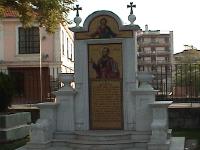
 Sunday, September 21st found us on the road again. We left Thessaloniki heading South until we came to Veria.
According to Acts, Paul fled here during the night and went to the Synagogue to preach. This monument was built on the hill where that is believed to have
been the location of the hill he preached from.
Sunday, September 21st found us on the road again. We left Thessaloniki heading South until we came to Veria.
According to Acts, Paul fled here during the night and went to the Synagogue to preach. This monument was built on the hill where that is believed to have
been the location of the hill he preached from.
|
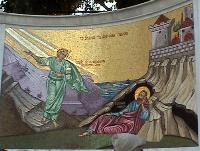
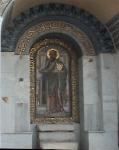
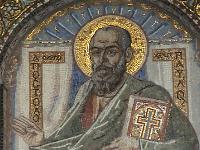
The center Mosaic is the oldest one it has existed 30 or 40 years, whereas the other two are only a few years old. The center steps actually come from the time of St. Paul. The Mosaic is a depiction of how historians believe Paul looked. Not very tall very little hair and with the jewish facial characteristics.
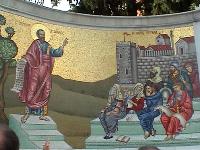
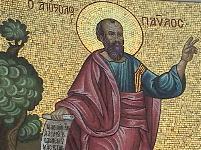
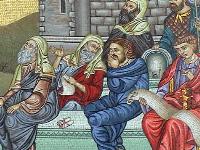
The Mosaic on the right portrays the apostle standing on the 3 step altar addressing the people of the city. You can see a Roman soldier, a pagan and Jewish person.
You have a mixed group there. Veria has always been a cosmopolitan city. Beyond the gathering is the city of Veria, so the Synagogue was actually outside the city.
|

Leaving Veria, we went to Vergina where we saw a magnificent excavation into the tomb of Alexander the Great's father Phillip II of Macedonia.
For some reason I can't find the pictures, maybe we weren't allowed to take photos inside here. We bought a book and here are a few scans of what we saw. If I find my pictures later
I'll modify this page.
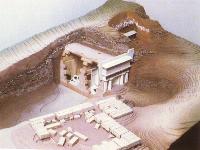
Apparently in order to prevent some invaders from looting their tombs, they were covered with dirt. This particular one we went to
see was the life work of Professor Andronikos, which he discovered in 1977.
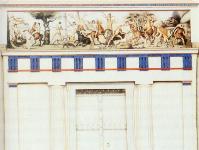
We walked inside the excavation and could see the where the burial chambers were uncovered to reveal the facades.
Above the main entrance to the tomb was a painting that represented the things the person buried inside liked to do when he was alive, such as hunting or sports.

When we had seen all the tombs, we proceeded into a museum that housed the artifacts that were found in the tombs. This image is of a
magnificent gold oak crown - the acorns are prominently displayed. There were several such crowns and decorative armor.
There were shields of ivory and gold, iron breast plates, swords and helmets. There were many vessels used for oils for the burial. Another interesting article found there were
miniature animals carved into ivory and small faces, one of which is the typical likeness of Alexander - a young boy dreaming.
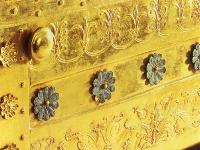

Probably the most impressive object on display there was the burial reliquary that Phillips bones were found in. It is solid gold with
elaborate decoration in gold flowers and blue rosettes. The top of the box has the "Sun of Vergina" embossed on it. This was the emblem of the Macedonian kings.
Another amazing aspect of the box is that they were
able to fit all the bones of the body inside it. The bones had been washed and wrapped in purple cloth, and the gold oak wreath was set atop the bones. The gold box was placed
inside a marble sarcophagus and this was found in the inner room of the larger crypt.