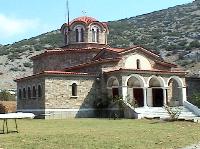
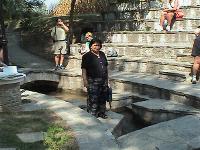
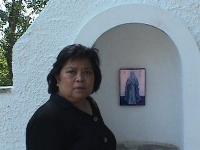
 Leaving Philippi, we took a short bus ride to Lydia, where St. Paul went to find the Jewish community of that time. There being no temple in Philippi, he went to the nearest natural flowing stream, where he knew the "Living Waters"
was where to find the Jews. Here he met Lydia a woman who sold purple cloths.
Leaving Philippi, we took a short bus ride to Lydia, where St. Paul went to find the Jewish community of that time. There being no temple in Philippi, he went to the nearest natural flowing stream, where he knew the "Living Waters"
was where to find the Jews. Here he met Lydia a woman who sold purple cloths.
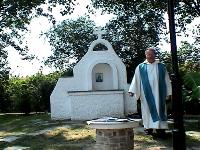
We celebrated Mass on this, the site where Paul met the women. Joe and Sherry Weddle and Fthr Paul read the scripture readings. See Acts 16 : 11-15.
Click here to download a windows streaming media of the readings. We then doused ourselves in the baptismal waters of the stream.
Being late for our appointment with Father Eleutherios, we quickly toured the Baptistry at the site of the flowing waters. Someone was setting up for a wedding or a baptism as we
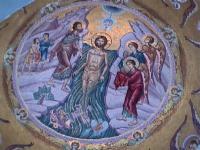
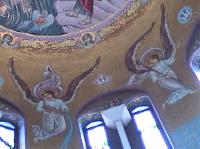
completed our mass at the stream. These pictures are of the wonderful mosaics of the baptistry. The stained glass windows were rather impressive too.
Next we visited St. John the Baptist church in Lydia where Father Bob introduced us to Father Eleutherios. The two seemed to be long time friends.
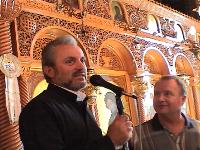
Father Eleuterios proceeded to explain the practices of the Orthodox Church and the history of the area.
In order for us to understand, Father Eleutherios would say a few sentences and Aleca would promptly translate.
Philippi is sacred to the people of Greece because this is where St. Paul first brought the Christian faith to Greece and eventually from here to the rest of Europe.
He explained that the area has always been a haven for refugees and that most of his current congregation fled to this area about 83 years ago from Asia Minor after World War I.
This is also the time when Aleca's parents came to Greece.
There are about 800 residences in the town and they all attend this church. They are small communtity but they have strong feelings about their faith.
Many of the town people who emigrated to the US to find work, return every summer to visit and eventually retire back to this
town to die in their own place.
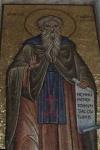
Father explained the Church was built and dedicated to St. John the Baptist and that is why you see an Icon depicting him as the second on the left.
Aleca restated the order of the Icons in the front of the church. On the left hand side you always see an Icon dedicated to Our Lady the Mother of God, and the first on the right is always to Christ the Lord of the Univers.
You can see in the St. John the Baptist Icon, his head on a platter, representing his being beheaded for the faith.
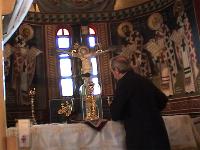
The church is a Byzantine design with a dome and three aisles. Father explained that everything in the Orthodox church is symbolic. He pointed out the Holy Altar which contains the holy of the holies.
In order to start the church you must santify the grounds with relics from those who have given their life for the faith. These are kept in the center of the Holy Altar. It is sealed and no one touches them.
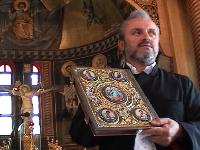
On top of the Altar is kept the Holy Gospel which contains the words of God.
Next he brought out a candle that burns constantly on the Altar. Before the resurrection of the Lord during the Easter Celebrations in Jerusalem a fire is lit.
They fly some of that fire to Athens and other places. The various churches receive this light and keep it burning day and night year round. Every candle they use is of pure olive oil.
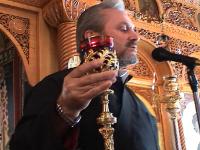
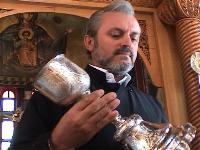
Then he brought out a beautiful silver chalice. This one was given to Father as a present from one of the families in the parish. It's is hand done and hand carved. It is dedicated to the
mother of family who passed away so everything on it symbolizes the memory of that beloved person.
Father then brought out the Holy Cradle, we call this the paten. During the celebration of the Holy Eucharist, the bread is placed on this, and he had a cross shaped cover that is placed over it.
The bread is baked with a special seal design. It has the shape of a cross in the middle of the loaf with letters that mean "Jesus Christ Wins".
He then explained how during the celebration, the seal is carved out, with the center piece reserved for Christ, the one on the left for his Mother, and the one on the right for the 9 legions of angels.
The last piece is consumed by Father after the congregation has received Holy Communion.
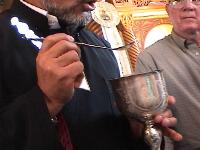
For the Communion, the bread is broken up into small pieces and mixed with hot water and wine in the Chalice. As each person comes to receive the body and blood, the Priest
flicks a spoonful of the mixture into their mouths. This is according to the words of Christ to the disciples that we should all take from the same cup.
Finally Father brought out a myrrh container that is used for Christening and Confirmation which are both done at the same time. There is a substance inside the container made from
forty different flavors symbolizing the grace of the Holy Spirit that the child is receiving. The myrrh is prepared at the Ecumentical Patriacade in Constantinople and from there all the churches receive a portion.
After the baptism, the oil is used to make the sign of the cross on the forehead, hands, heart, etc to complete the confirmation of the Grace of the Holy Spirit.
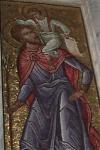
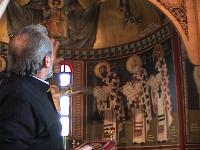
Next he began to explain the artwork inside the santuary. Gifts of wine and bread were presented to us along with some pure beeswax candles and incense. He then invited us to the Parish Hall for some juice and cookies. Some of the girls collected some of the
fragent Basil that was growing outside the Hall on our way out. To download entire talk - Video
Following lunch we headed back on the long trip to Thessaloniki, passing through excellent views of the water. We saw plenty of flocks of
sheep, tobaco fields, orchards,etc.

 Covering the Altar is the Holy Shroud. This cloth depicts the most critical moment of Jesus life, his crucifixion and preparation for burial. Without this cloth, the father can not perform the Holy Eucharist.



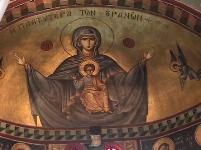 The ceiling above the Holy Altar is called the Patetera and always has a painting of the Madonna with the extended arms
seated at the throne with the baby Jesus. They extend their prayers to Our Lady who is considered Mother and Friend.
The ceiling above the Holy Altar is called the Patetera and always has a painting of the Madonna with the extended arms
seated at the throne with the baby Jesus. They extend their prayers to Our Lady who is considered Mother and Friend.

When we left here, we took a short drive to Kavala, formerly Neapolis. This is the port where Paul first landed in Europe.
The town used to be a big tobacco processing area.
Service was super slow at the restaurant we stopped at, but the
food was good. Of course we were so hungry at that point, almost anything would have tasted good.
Veria
Itinerary