|
From Wikipedia, the free encyclopedia
The Battle of Mactan was fought in the Philippines on April 27, 1521. Background
On 16 March 1521 (Spanish calendar), Magellan sighted the mountains of what is now Samar while on a mission to find a westward route to the Moluccas Islands for Spain. This event marked the arrival of the first Europeans in the Archipelago. The following day, Magellan ordered his men to anchor their ships on the shores of Homonhon Island.
There, he befriended Rajah Kulambu and Rajah Siagu the chieftain of Limasawa,
who guided him to Cebu. He, and his queen were baptized into the Catholic faith,
taking the Christian names Carlos, in honor of King Charles of Spain, and Juana,
in honor of King Charles' mother. To commemorate this event, Magellan gave Juana
the Santo Niño, an image of the infant Jesus, as a symbol of their new alliance.
As a result of Magellan’s influence with Rajah Humabon, an order had been issued
Most chiefs obeyed the order. However, Datu Lapu-Lapu, one of the two chiefs
within the island of Mactan, was the only chieftain to show his opposition.
Lapu-Lapu refused to accept the authority of Rajah Humabon in these matters.
This opposition proved to be influential when Antonio Pigafetta, Magellan’s voyage
chronicler, writes:
"On Friday, April twenty-six, Zula, the second chief of the island of Mactan,
sent one of his sons to present two goats to the captain-general, and to say that
he would send him all that he had promised, but that he had not been able to send
it to him because of the other chief Lapu-Lapu, who refused to obey the king of
Spain."
Rajah Humabon and Datu Zula suggested that Magellan go to the island of Mactan
The battle
According to the documents of Italian historian Antonio Pigafetta, Magellan
tried to convince Lapu-Lapu to comply with Rajah Humabon's orders the night before
the battle:
Pigafetta writes how next morning Magellan deployed forty-nine armored men with
swords, axes, shields, crossbows and guns, and sailed for Mactan in the morning of
April 28. Filipino historians note that because of the rocky outcroppings, and
coral near the beach, the Spanish soldiers could not land on Mactan. Forced to
anchor their ships far from shore, Magellan could not bring his ships' firepower
to bear on Datu Lapu-Lapu's warriors, who numbered more than 1,500.
When morning came, forty-nine of us leaped into the water up to our thighs, and
walked through water for more than two cross-bow flights before we could reach the
shore. The boats could not approach nearer because of certain rocks in the water.
The other eleven men remained behind to guard the boats. When we reached land,
[the natives] had formed in three divisions to the number of more than one thousand
five hundred persons. When they saw us, they charged down upon us with exceeding
loud cries... The musketeers and crossbow-men shot from a distance for about a
half-hour, but uselessly...
Magellan then tried to scare them off by burning some houses in what is now Buaya, known then as Bulaia.
Seeing that, the captain-general sent some men to burn their houses in order to
terrify them. When they saw their houses burning, they were roused to greater fury.
Two of our men were killed near the houses, while we burned twenty or thirty
houses. So many of them charged down upon us that they shot the captain through the
right leg with a poisoned arrow. On that account, he ordered us to retire slowly,
but the men took to flight, except six or eight of us who remained with the captain.
The natives shot only at our legs, for the latter were bare; and so many were the
spears and stones that they hurled at us, that we could offer no resistance. The
mortars in the boats could not aid us as they were too far away.
Many of the warriors attacked Magellan; he was wounded in the arm with a spear
and in the leg by a kampilan. With this advantage, the Lapu-Lapu's troops finally
overpowered, and killed him. He was stabbed, and hacked by spears and swords.
Pigafetta and the others managed to escape,
Recognizing the captain, so many turned upon him that they knocked his helmet
off his head twice... An Indian hurled a bamboo spear into the captain's face, but
the latter immediately killed him with his lance, which he left in the Indian's
body. Then, trying to lay hand on sword, he could draw it out but halfway, because
he had been wounded in the arm with a bamboo spear. When the natives saw that, they
all hurled themselves upon him. One of them wounded him on the left leg with a
large cutlass, which resembles a scimitar, only being larger. That caused the
captain to fall face downward, when immediately they rushed upon him with iron and
bamboo spears and with their cutlasses, until they killed our mirror, our light,
our comfort, and our true guide. When they wounded him, he turned back many times
to see whether we were all in the boats. Thereupon, beholding him dead, we, wounded,
retreated, as best we could, to the boats, which were already pulling off...
According to Pigafetta, several of Magellan’s men were killed in battle, and a
number of natives converted to Christianity who had come to their aid, were killed
by warriors, and soldiers. There are no official records of the number of casualties
in the battle, although Pigafetta mentions at least 3 Christian soldiers killed
including Magellan.
Magellan's allies, Humabon and Zula, were said not to have taken part in the
battle due to Magellan's bidding, and watched from a distance. Pigafetta reports
that the Christian king Humabon sent a message saying that if they return the
bodies of Magellan and his crew, they would give as much merchandise as they wished.
Magellan’s body, however, was never recovered from the natives.
Some of the soldiers who survived the battle and returned to Cebu were poisoned
while attending a feast given by Humabon. Magellan was succeeded by Juan Sebastián
del Cano as commander of the expedition, who ordered the immediate departure after
Humabon's betrayal. Del Cano and his fleet sailed west and returned to Spain in 1522,
completing the first circumnavigation of the world.
In Philippine culture
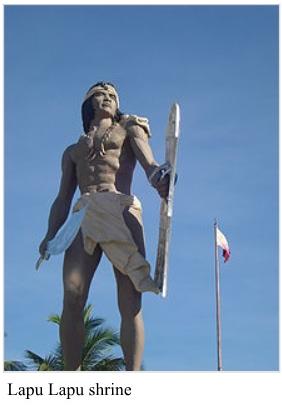
Today, Lapu-Lapu is retroactively honored as the first "Philippine national hero"
to resist foreign rule, though formally the territory of the "Philippine Islands"
had yet to be established or even named at the time. He is remembered by a number
of commemorations: statues on the island of Mactan and the Cebu Provincial Capitol,
a city bearing his name, and a local variety of red grouper fish. Kapampangan
actor-turned-politician Lito Lapid starred in a film called Lapu-Lapu, and novelty
singer Yoyoy Villame wrote a folk song entitled "Magellan" that tells a humorously
distorted story of the Battle of Mactan.
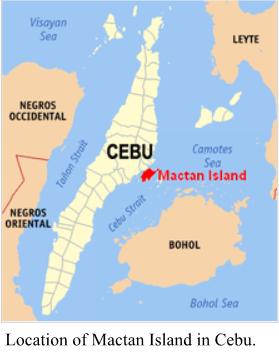
There is a spot in Mactan Island called the Mactan shrine where the battle is
reenacted during its anniversary. In the same shrine, next to the Lapu-Lapu statue,
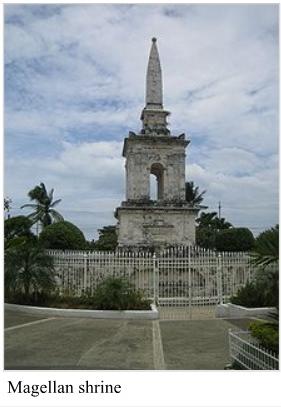
there is a semi-destroyed obelisk erected in Magellan's honor by the Spanish
colonial authorities and defaced shortly after the US military occupation of the
Philippines.
Magellan is also honored for bringing Christianity to the Philippines in general
and the Santo Niño (Child Jesus) to Cebu in particular. The Magellan's Cross and
the aforementioned Magellan's shrine were erected in Cebu City and Mactan Island.
Many landmarks and infrastructures all over the Philippines bear Magellan's name,
mostly using its Spanish spelling (Magallanes), which is also a widely used
Filipino surname.
Legends
Some natives believe that in his final years, Lapu-Lapu did not die, but turned
into a stone, and is forever guarding the seas of Mactan. Fishermen in the island
city throw coins at a stone shaped like a man as a way of asking for permission to
fish in the chieftain’s territory.
Another story passed on by the natives of the land says Lapu-Lapu became the
statue placed on a pedestal at the center of the plaza. The statue faces the old
city hall building where the mayors used to hold office and once held a crossbow
in the immortal stance of someone about to shoot an arrow at an enemy. The people
of the city decided to change this crossbow with a bolo after a succession of three
mayors died due to a heart attack.
|
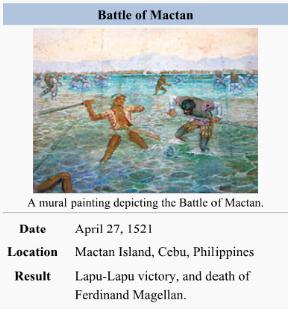 The warriors of Lapu-Lapu, a native chieftain of Mactan Island, defeated Spanish forces under the command of Ferdinand Magellan, who was killed in the battle.
 to the nearby chiefs that each of them were
to provide food supplies for the ships, and convert to Christianity.
to the nearby chiefs that each of them were
to provide food supplies for the ships, and convert to Christianity.
 and force his subject chieftain Datu Lapu-Lapu to comply with his orders. Magellan
saw an opportunity to strengthen the existing friendship ties with the ruler of the
Visaya region and agreed to help him subdue the rebellious Lapu-Lapu.
and force his subject chieftain Datu Lapu-Lapu to comply with his orders. Magellan
saw an opportunity to strengthen the existing friendship ties with the ruler of the
Visaya region and agreed to help him subdue the rebellious Lapu-Lapu.