 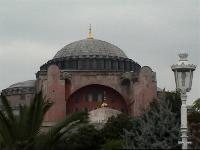
Next we were standing outside the entrance to the Church of Hagia Sophia, Divine Wisdom.
This church was reconstructed by Justinian in 527 on the site of a prior church destroyed in the Nike riots of 532. This church was completed
in 537 and reigned as the greatest church in christendom until the conquest of Constantinople in 1453.
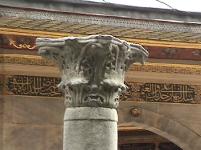
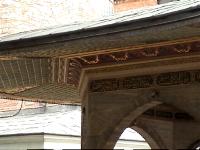
While we waited outside in the stone courtyard for our tickets, the first Turkish monument
which catches eye, is the impressive fountain for ablutions (Sadirvan). Built to serve as a
place for ritual ablutions before praying, it is a superb example of Ottoman
baroque art. It was built by Sultan Mahmud I in 1740.
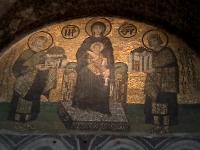
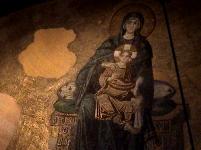
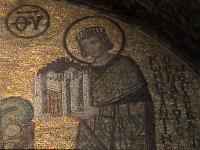
Upon entering the church we proceeded to the inner narthex where a magnificent mosaic panel of
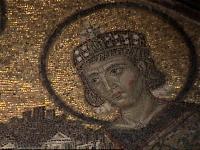
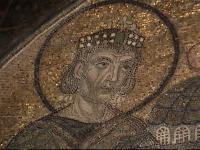
the madonna and child. The emperor Constantine is on the right with a model of the city. Emperor Justinian is on the left with
a model of the church, dedicating their works to the Virgin Mary and Jesus Christ. If you look at their faces they are exactly alike
, a characteristic of the art of 9 th and 10 th century when these mosaics were added. Justinian opposed the use
of mosaics and did not include them in the original construction.
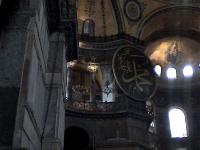
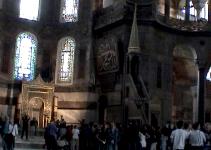
Passing through the inner narthrex into the main church one is immediately struck with the hugeness of the building.
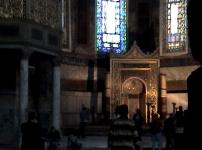
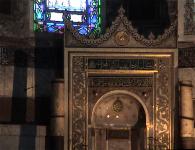
In the center of the far semi-dome stood out the golden Mirhab which indicates the direction
to pray towards the holy city of Mecca for the Islams.
Where as directly above the mihrab in the center of the high dome is the Madonna with Child Mosaic that was
typical of the early Christian Churches.
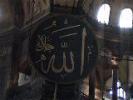
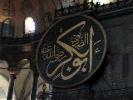
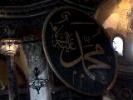
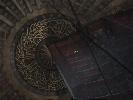
Caligraphical huge plates that indicated Allah and Mohammed on the left and right hand side of the niche respectively,
and the Four intiial Caliphs of Islam are on the side walls. These 7.5 meter diameter plates are accepted as some of the greatest examples
of calligraphy in the world of Islam. The gilt Arabic letters are the work of master calligrapher Mustafa Izzet Efendi.
A very tall Mimber is stationed to the right of the Mihrab. From this perch the Friday's
readings and sermons are issued.
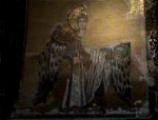
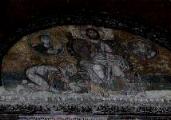
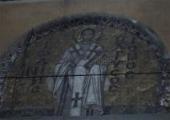
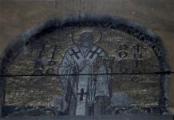
During the Latin Invasion of the 13 th century the mosaics were severely damaged.
The Ottoman conquest saw them covered with lime. They have been restored to some extent recently.
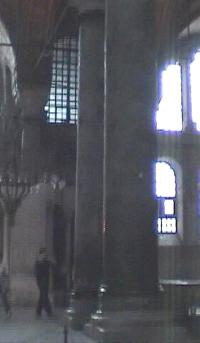
At the time the church was built, paganism was outlawed. The four large columns from the Temple of Artemis is Ephesus were therefore brought here and used in the section called the omphalion. The Temple of Artemis was one of the seven wonders of the world at that time. omphalion means navel or the center of the world. This is where the rulers were
crowned. They would bring a throne to put in the middle of the marble circle and a lot a fanfare accompanied the crowning ceremonies.
Another unique feature was the six winged seraphs located in each corner between the lower levels and the
high domes. Angels carry the message from man to God. See Isaiah 6:2.
The mosaic at the top of the center dome has not been uncovered due to the beauty of the
Calligrphy that covers it.
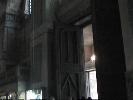
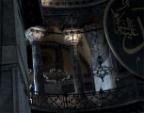
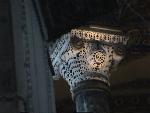
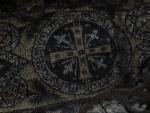
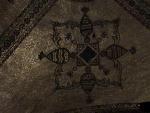
Finally we left out the huge doors. But before we go to lunch, here are a few more
views from inside the church.
|