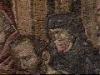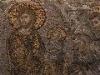
Arguably the most impressive site of our entire trip happened this AM.
The original Chora Church was constructed in the 4 th century just outside the walls of Constantinopolis. The name means
"at the countryside". During the 13 th century under the auspices of Theodor Metochites it got its last addition of the exterior narthex.
He spent his wealth for charity. During this period some magnificient mosaics were incorporated into the church. We started at the passage from the
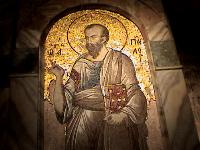
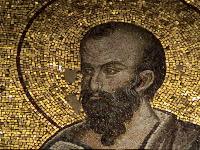
inner narthex to the nave. The illustration of St. Paul and of St. Peter. I didn't get a any good pictures of St. Peter, but was able to
capture St. Paul.
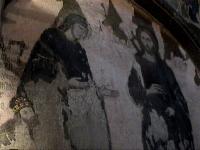
The largest mosaic of the museum is this view of Jesus, Mother Mary, Isaak Komnenos and Nun Melanie.
Isaak Komnenos restored the church in the 11 th century. Melanie was a courtly princess who perhaps contributed significant moneys
for the restoration of the monastic community. Colored rocks from the nearby streams were used to fashion the mosaics.
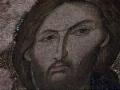

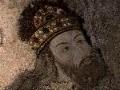
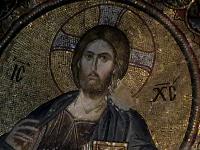
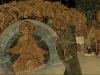
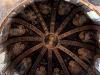
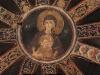
The first dome we viewed had Jesus at the center and he was surrounded by the chronology from
of his descendency from David.
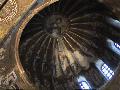
Dilek then backed us up against the wall to be able to see the mosaics of the miracles of Jesus.
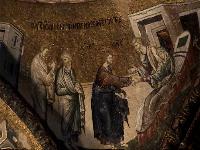
Curing of St. Peter's Mother.
|

Woman in crowd secretly drawing the curing power from Jesus.
|
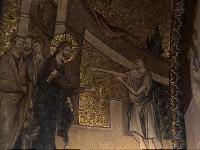
Man extending his arm asking Jesus: "Heal Me."
|
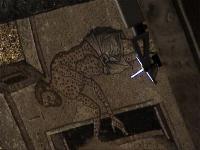
Leper being cured by Jesus.
|
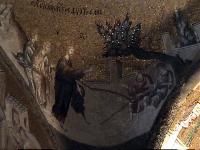
Jesus restoring the sight to the blind.
| |
When the crowd moved away from the one wall, Dilek rushed us over to get a good view of the mosaic
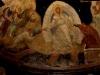
of the Dormition of Mary. She noted that there are only a handful of such depictions of the deathbed of Mother Mary and Europe.
This one was a fine example of early Renaissance art, it bears a lot of resemblence to the painting of the artist Giotto, from Italy.
The blue dress and skirt around the bed accent her distinctive presence. There are six apostles on the left and six on the right. They are
all looking over each others shoulders to bring your attention to Mary in the center.
What makes this art style Renaissance is the many varied expressions on the faces of everyone in the picture.
The distinctive face of St. Paul is front stage, at the foot of Mary. St. Peter on the other side appears to be totally bummed out shaking the incense burner.
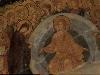
In the center of the picture is Jesus with a baby in hand. The baby represents the soul of the Virgin Mary that is about to be raised up into heaven.
Jesus is surrounded by a white light that represents his holiness. Within that light
you can see angels. There is a six winged angel above Jesus Christ that is about to take the baby up into the sky.
Looking at the city in the background, many have speculated whether that was Jerusalem or Ephesus. Since St. John was imprisoned near Ephesus, there is
a lot of speculation that Mary spent her last days near there also, since he was entrusted to take care of her by Jesus on the Cross.
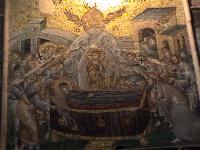
Following Dilek's explanaiton, we continued to look for awhile, but when an opening appearied in the next corridor,we quickly stepped to that side section.
The paraclession hall was constructed in the 14 th century as a place to bury the dead.
It is decorated with frescoes that have death as the dominant theme.
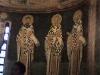
At the lowest level is frescoes of some of the early church leaders. St. Basil was a popular leader for this area. Directly above them is a depiction of Jesus
breaking the gates of hell and pulling Adam and Eve to him. Between the busted pillars are keys strown about the figure of a black man who is the guardian of the underworld.
In the center as you start to move up to the next level you see two angels with a scale, weighing the good deeds and the bad for each person.
On the left you see rising up into heavens those that led good lives and on the right you see marching into hell those that did not. The big red patchy area being hell.
On the far right of the red area you can see Satan lurking in the shadows. He is fanning the flames.
Moving up into the next level you see Jesus Christ in a yellow cloak. John the Baptist in the green cloak is to his right and the Virgin Mary in purple dress to his left.
They are pleading with Jesus for the forgiveness of sins. St. John has his typical depiction of the dishaveled hair associated with his living in the desert.
Above this scene in the center is an angel with a white snail like substance. This is actually a papyrus scroll and he is unfolding it. In the book of Revelations there is a passage
where it is said there will be a time when all will be made known to us. This image depicts that passage. Within the scroll you can make out images of stars and the moon.
The central dome of this corridor is decorated with Mary holding the infant Jesus, surrounded by saints. On the side walls are many illustrations of soldiers. Often Roman soldiers
were on the frontiers of the empire and would hear the Word of God and convert. They were targets for Martyrdom.
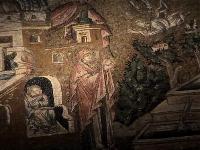

Around the corner we were introduced to scenes from the life of Virgin Mary. This first frescoe shows the
annunciation to St. Anne that she will give birth to the Virgin Mary. An angel brought the good news to her.

In the next scene Anne and Joachim, the father of Mary, are hugging for joy of the Good News.

The birth of the Blessed Virgin Mary.

When Mary came of age to marry, the Jewish Priest asked all suitors to bring their staff and the owner of the staff that bloomed was to be
declared the husband of Mary. This scene shows how Joseph's staff came alive with leaves growing out. He is shown stepping forward to claim his bride.

This scene shows Joseph and a servant leading Mary off to her new home.
Several other scenes of Mary's life were around, that I didn't get clear shots of. This last scene shows a mature Mary with Joseph heading
off to work. His servant carries the lumber in a sack for the day's work.
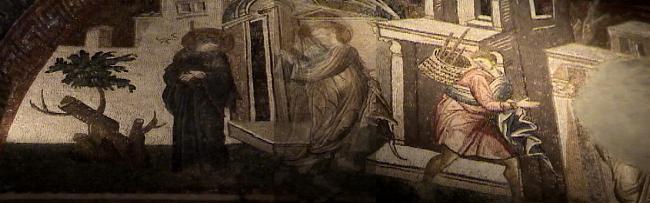
This next section had many depictions of biblical stories especially about the life of Jesus.
Temptations of Jesus Christ is the theme of the first two Mosaics we came to. In the first panel you see the devil
suggesting that Jesus turn the stones into bread. In the next panel you see him asking him to throw himself from a high place to see if the angels stop his fall.
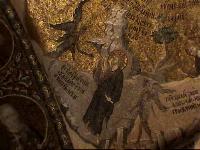
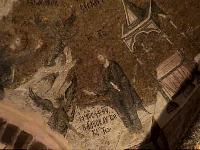
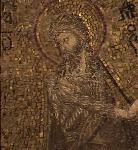
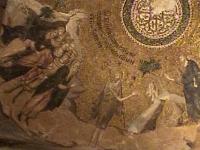
Next we see a panel where Jesus comes to John the Baptist to receive baptsim.
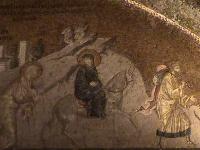

The next scenes we see Mary and Joseph heading to the their birth city for the census and when they arrived
and were registering.
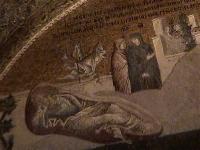
In this scene, Joseph is asleep and the angel appears to him in a dream telling him it's all right to marry the Virgin.
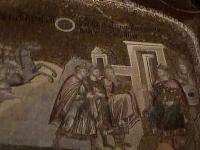

Three Magi's following the star ask the King where the child was born at.
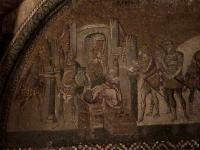
The King ordered the murder of all children under 6 of age and the soldiers are carrying out the crime.
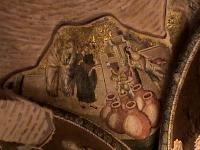
Finally there was this mosaic of the turning of the water to wine at the wedding feast in Cana.
|